A Time Like Today
The real-life Gilded Age events that inspired The History of Light
By Michael W Small
In 1995, when writing plays was my unprofitable side hustle, I took a profitable job as an editor at one of the first general interest websites, hotwired.com.

This may seem totally unrelated to a musical about electricity in the Gilded Age. But actually, it's where The History of Light began. As I continued in jobs at various websites for the next 27 years, I kept thinking that the tremendous change at lightning speed couldn't be new. There had to be a similar time in history.
Which brought me back to my unprofitable pastime. I started looking for a parallel time in history, hoping that I could write a play about it.
In Search of Electricity
After a little research, I learned that my image of tea-sipping Victorian times was 100% wrong. In fact, their world was torn apart and changing at an astounding pace by technology — especially electricity.
I decided to focus on the time when electricity became common in private homes — the equivalent of getting a high-speed Internet connection in the late 1990s. That’s when I fell into a seemingly bottomless vortex. After months of research at libraries and on the Internet — even after I called the promotion department at ConEdison — it seemed as if no one could give me a specific date when electricity became common in homes. Recently, I consulted ChatGPT and got yet another vague answer. So, until someone reading this digs up a source for me, I won’t know the actual turning point.
But I did discover some interesting details. Such as, in 1882, when Thomas Edison flipped the switch in America's first electric power plant on Pearl Street in New York City, he had a big problem. He couldn't get electricity to travel more than a mile.
He didn't solve this problem quickly. For years, only homes and businesses in the close vicinity of Pearl Street could take advantage of the power-generating dynamos, one of which was named after Jumbo – the famous elephant in Barnum and Bailey's circus.
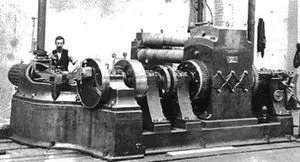
Edison’s Pearl Street dynamo, around 1882
The First Rays of Light
This doesn't mean that electricity failed to spread beyond lower Manhattan.
In the late 1880s, New Yorkers got used to seeing electric lights on city streets. Extremely bright "arc lights" were placed at the top of very tall poles in Madison Square and other locations. For better or worse, they pioneered light pollution, illuminating the city for many blocks. From 14th to 34th Streets, the lights were so bright that it inspired the first use of the term, The Great White Way.
Other public places, like theaters and department stores, went electric. They were powered by individual generators, much smaller than Edison's dynamos and incapable of lighting hundreds or thousands of homes.
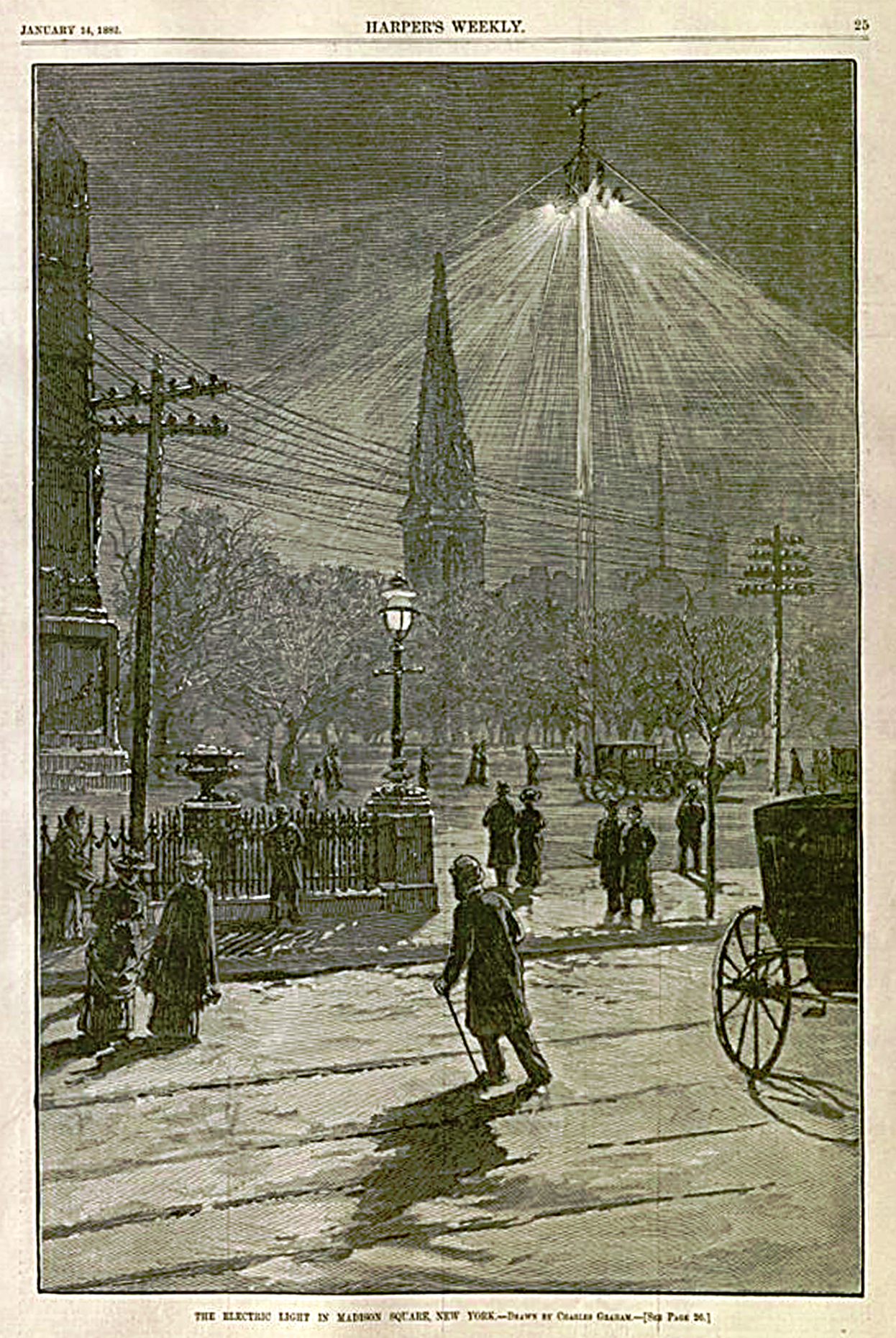
Arc lights in Madison Square, New York City
The Early Adopters
A few wealthy people were ahead of the curve. JP Morgan set up a generator behind his home, which still stands on Madison Avenue —though the generator is long gone. His was so loud that it was a infuriating to his neighbors, though arguing about it with JP Morgan probably was more difficult than moving away.
William and Alva Vanderbilt also did a test of electricity in their Fifth Avenue mansion until they started watching smoke billow out of their walls. Turns out, their fancy wallpaper was entwined with metal threads that touched the electric wires and became a genuine fire hazard. Alva had the electric wires removed and went back to gas lighting.
Her sister-in-law Alice did, however, pay tribute to the electric age, by wearing an electric gown (designed by Worth) to an 1883 costume ball at Alva and William’s new mansion at 660 Fifth Avenue. The dress lit up with help from a battery. That gown, which was donated to the Museum of the City of New York, is no longer as glittery but still a wonderful artifact of those times. It inspired a key scene in The History of Light.
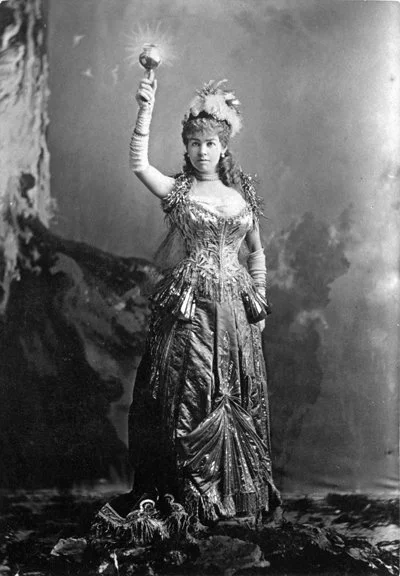
Alice Vanderbilt’s electric dress, 1883
Though many people wanted electricity in their homes, there were naysayers too. The electric wires atop wooden poles around Pearl Street presented a genuine hazard —particularly when they were knocked down during storms, leaving live wires on the street. I found an article about a worker who was electrocuted after climbing a pole to repair a wire. Because it wasn't clear how to safely get him down, he hung there for an extended period.
Catching Up With History
To better understand the Electric Age, I knew that I had to fill huge gaps in my knowledge of 19th century America. In fact, I barely knew a thing about American history. I also knew surprisingly little about the history of the European countries that created colonies in America, and it was difficult to catch up because I knew so little about their ancient origins.
So I started with the Greeks.
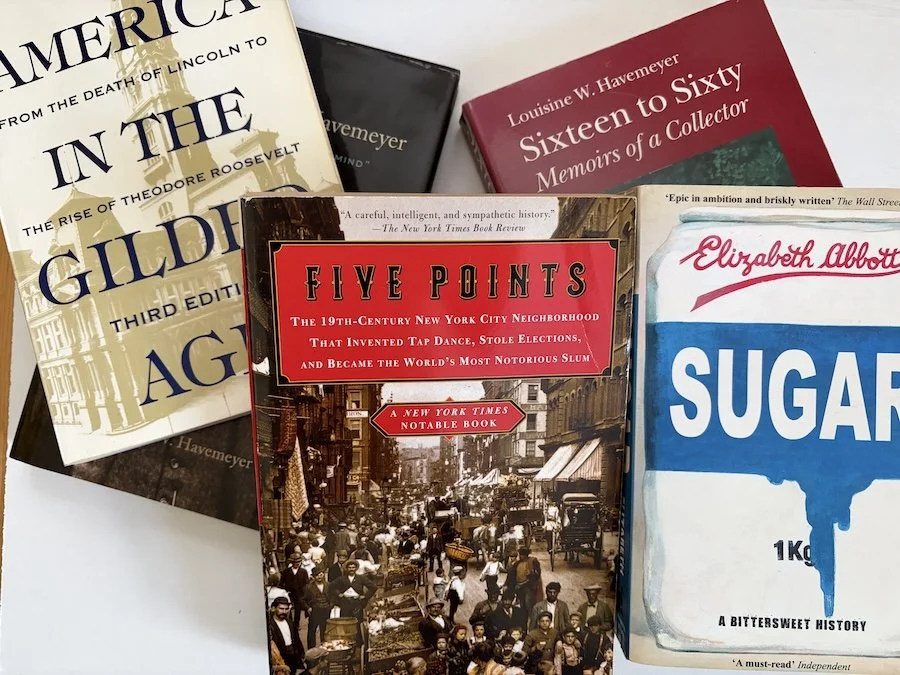
For about five years, I read ancient history, modern European history, and the entire multi-volume Oxford American History series. Then I started to hone in on the time and place that most interested me, reading the huge miraculous tome Gotham for New York City history and several books about Victorian America.
Meet… The Havemeyers
Elizabeth Abbott’s informative— and often upsetting — book Sugar introduced me to a fascinating New York family, the Havemeyers. Starting in the early 1800s, they processed sugar, eventually generating a large percentage of the world's refined sugar at a Brooklyn factory on the East River. (It eventually became the Domino Sugar Factory and is now fancy stores, offices, and apartments.) In the 1920s, Louisine Havemayer wrote 16 to 60: Memoirs of a Collector, a detailed account of her life as an art collector, going to Europe with her husband the sugar magnate Henry Osborne Havemeyer and their friend Mary Cassatt. There, they collected a massive quantity of art – especially an enormous amount of Degas paintings and other Impressionist works, which they brought back to their mansion on Fifth Avenue.
Henry had married Lousine after a failed marriage with her aunt Louise. Some upright Victorians — including Teddy Roosevelt's wife Edith — found this so scandalous that when Edith visited the Havemeyer home to see their art collection, Lousine was not allowed to be there. It wasn't proper for the two women to meet. Ultimately, after Henry's death, the family's Degas collection, as well as Tiffany glass and other precious objects, became a highlight of the permanent collection at the Metropolitan Museum.
There were other scandals. At one point, it was discovered that Henry's company had rigged the scales for weighing the sugar cane imported from the south —saving money on taxes, since he paid by the pound. Lousine was so upset about this situation — and the death of her husband and other family members - she attempted suicide. But she was convinced to start again, devoting much of her energy to the women's suffragette movement.
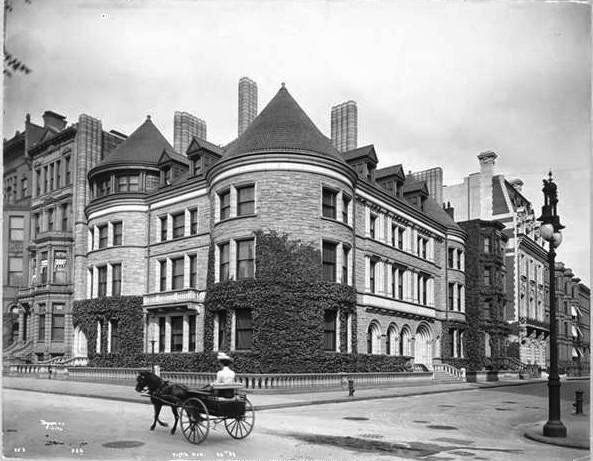
The Fifth Avenue mansion of sugar baron Henry Havemeyer and his wife Louisine
The Sugar Connection
Before my reading spree, I assumed that most northerners were repulsed by anything related to slavery. So it shocked me to learn about the close tie between New York City businesses and the southern plantations. Sugar plantations were brutal, among the most deadly working conditions in human history. A large percentage of enslaved people died while planting and picking sugar cane, not living long enough to raise families. Not only were the fields horrifically hot and wet and full of rats, but the workers who sucked on the cane plants developed diseases, and died, from a diet based on sugar.
I couldn't get this out of my mind, which is why the young newlyweds in my musical are heirs to a sugar refining fortune. Though the people in my story are entirely fictional, I included one reference to the Havemeyers. The sugar baron in The History of Light gives his daughter a gift of the painting The Third Class Carriage by Daumier, which I saw in the Havemeyer collection at the Met.
Gilbert and Sullivan
In my Gilded Age reading, I constantly came across references to the operettas of Gilbert and Sullivan — in the way that social histories today might mention the Beatles. So despite the fact that I wasn’t a fan, I started listening to their music. The style wasn’t right for my story. But the lyrics and melodies often aligned perfectly with my characters. I had to stew on that for awhile. But after some hesitation, I began years of searching for my current collaborators. They helped me update the relevant songs, while still paying tribute to the source.
The Gilded Age and The Internet Age
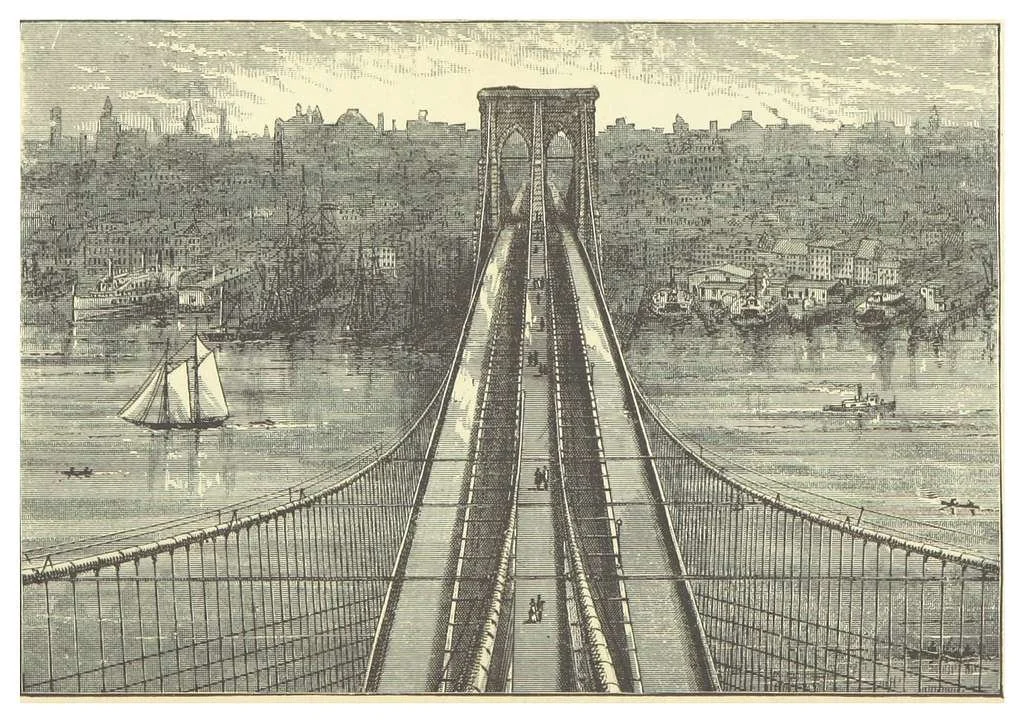
Ultimately, I found many similarities between New York in the Gilded Age and our own time — the impossibly fast pace of change, the huge gap between rich and poor, the insidious racism. Many wonders of the 1880s are still current - elevators, The Brooklyn Bridge, The Statue of Liberty, multi-story buildings, the ability to send transatlantic messages instantly (at that time, by telegraph).
I’m not alone in being fascinated by this. After The History of Light had two readings (at New York's HOWL Festival and at La Mirada Theatre for the Performing Arts in L.A.), a friend told me she had a part in the Julian Fellowes TV series The Gilded Age. At first, I was upset to hear that Fellowes intended to claim the same time period as my musical. But then I decided to be happy about it. Maybe the TV series will increase interest, not divert it.
For now, I’m glad that I found what I most needed – the story in The History of Light, which begins with a song called “A Time Like Today.” The lyrics insist that there never was a time like the 1880s in New York City. But, of course, I’ve learned otherwise.
It’s a time when everything we know will change
The past is gone — it has no similarity
We depend on gadgets that are new and strange
They boost our speed — but not always our clarity
(From “A Time Like Today,” The History of Light)
How and why did Gilbert and Sullivan’s songs get transformed into pop and hip-hop for The History of Light?
Find out in an article on the music and technology website Valontia: Hip-hop Meets Opera: I Had To Do It